George Orwell and William Morris influence my creative direction. The former inspires me with his strong sense of social justice. The latter makes me realise that art is to be enjoyed by all, not exclusive to a select few.
I first read George Orwell’s Shooting an elephant at school, then I read Animal Farm when I was studying English Language and Literature at the International Islamic University (IIUM) in Malaysia. Then I went to the UK and worked in publishing, journalism and marketing for 25 years.
A family away from home
For most of the time I was in the UK, I was a card-carrying member of the National Union of Journalists (NUJ) UK. Away from family, my union and publishing colleagues, apart from my lovely Fulham and Brentford neighbours, were my family that kept us on the straight and narrow. Actually, it was my former editors at The Sun Daily (Malaysia) – Premesh Chandran, the founder of Malaysiakini – who advised: “Salina, join the NUJ Malaysia. It’ll help your colleagues”. I joined the NUJ UK whilst I was working for The Moodie Report in London.

Imagine how proud I was to be admitted to University College London (UCL), one of the top 10 universities in the world (and not on any scholarship), not because of the Red Brick prestige, but because Orwell and his wife worked on the campus of the University of London. I read about his activism, his observation of Jeremy Bentham’s panopticon theory that influenced his concept of ‘Big Brother’. Bentham was the founder of UCL. His embalmed remains are still on display in a box on campus for students to see.
Enjoy the fruit of your labour
I read on Marxism for my postgrad paper, and read more about ‘communism’ as proposed by the designer William Morris. I realised then that the notion of Communism in the UK is different than that in the East. Morris’s communism proposes the idea of compassionate sharing of the arts, culture and resources (equity), with a forward-looking goal inspired by the past. His communism is embodied in the Arts and Crafts movement. It’s not about Year Zero massacres, gatekeeping, guerilla activities, social unrest and racial polemic as what we had seen during the Emergency periods in Southeast Asia.
Morris’s communism is embodied in the Arts and Crafts movement. It’s not about Year Zero massacres, gatekeeping, guerilla activities, social unrest and racial polemic as what we had seen during the Emergency periods in Southeast Asia.
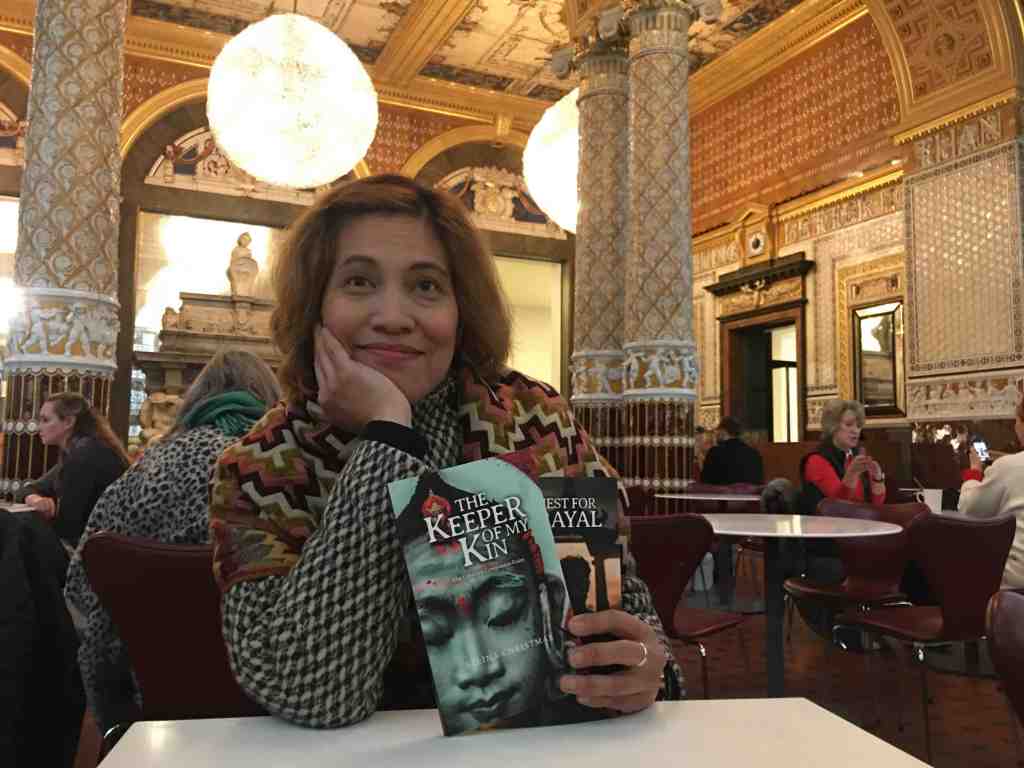
The proof lies in the cafe room that Morris designed at the Victoria & Albert Museum (pictured). That luxury is for all labourers to enjoy. His gift to us is his design. It’s not a rejection of tradition. Instead, Morris’s cafe embraced the spirit of the arts and crafts. The ornate cafe is not habitus (objects of status to be desired). They are the happiness he shares with us.

If you ever make it to the William Morris café (the Gamble, Poynter and Morris Rooms), do so. On the wall is inscribed the words from the Ecclesiastes (part of the Old Testament): “There is nothing better for a man than that he should eat and drink, and make his soul enjoy the good of his labour”. It’s his homage to the labourers and the labour movement, but still drawing from tradition and spirituality. The arts for the masses are not a rejection of tradition and belief system.
So if you see me posting pictures of plants, or occasionally my drawings, that’s me sharing my joy, the good of my labour, with you.
Orwell was a champion for the labour movement and critical of the establishment. But he also cautioned against authoritarianism (hence “Animal Farm”) in the name of dogma.
A good, honest work is a joy
Orwell was a champion for the labour movement and critical of the establishment. But he also cautioned against authoritarianism (hence “Animal Farm”) in the name of dogma. Be upright, he says, but be careful, his stories remind us. Be very mindful of dogmas, of seductive powers and temptations that sway us.
I have a few old press cards with ‘National Union of Journalists’ written on them. Whenever I see this image of Orwell’s card, I feel reassured that my literary path, past and present, is still on the straight and narrow.

More on The Constant Companion Tales
- A Request For Betrayal (Paperback: Part Four & Five, Amazon UK, £9.99; Amazon SG, from $20; Waterstones, £9.99; Barnes & Noble, $9.99, and at major bookstores globally)
- The Keeper of My Kin (Paperback: Part One, Two & Three, Amazon UK, £9.99; Amazon SG, from $24; Waterstones, £9.99; Barnes & Noble, $9.99, and at major bookstores globally)
- The series: The Constant Companion Tales (E-book, Amazon Kindle)
- Part One: The Red-Haired Gurkhas (E-book, Amazon Kindle, £2.99)
- Part Two: The Tiger-Man and His Constant Companion (E-book, Amazon Kindle, £2.99)
- Part Three: The Night of the Flying Blades (E-book, Amazon Kindle, £2.99)
- Part Four: The Brotherhood of the Tiger-Men (E-book, Amazon Kindle, £2.99)
- Part Five: A Truce Made In Blood (E-book, Amazon Kindle, £2.99)
- Part Six: The Devil from the Deep (E-book, Amazon Kindle, £2.99)
- Part Seven: Scissors in the Fold (E-book, Amazon Kindle, £2.99)
 Salina Christmas